
Search Indiana Genealogy Records
Indiana genealogy records include birth certificates, death records, marriage licenses, and court documents held by the Indiana Department of Health and all 92 county health departments across the state. Birth and death records date to 1882 at the county level, with statewide registration starting in 1907 for births and 1900 for deaths. You can search these records online, request them by mail, or visit a county office in person. This guide covers the key Indiana genealogy agencies, how to request records, what each document contains, and where to find older historical materials for family history research.
Indiana Genealogy Records Quick Facts
Indiana Genealogy Records Overview
Indiana holds several types of records that support genealogy research. Birth records, death certificates, and marriage licenses are the most common sources. County health departments keep local birth and death records from 1882 onward. The County Clerk in each county holds marriage records going back to county formation, often into the early 1800s. Court files, probate records, land deeds, and naturalization papers also help trace family lines in Indiana. Each type is held by a different agency. Knowing which office to contact saves a lot of time when you start your Indiana genealogy search. Under Indiana Code 5-14-3, most public records are open to the public, including genealogy records held at state and county agencies.
Indiana's vital records system works at two levels. The county level handles local registration and issues most certified copies. The state level tracks records statewide and keeps more recent copies. Birth records have been required at the county level since 1882, with statewide registration becoming general by 1920. Death records follow the same pattern, starting in 1882 at the county level and 1900 statewide. The Indiana Department of Health maintains a statewide marriage index from 1958. For marriages before that year, you contact the County Clerk in the county where the marriage took place. County Clerks hold marriage records going back to county formation in most cases. Some counties have records dating back to the early 1800s. The Indiana Genealogical Society at indgensoc.org has county pages listing which records each county holds and where to find them.
Three Indiana cities maintain their own municipal health departments. Gary, East Chicago, and Fishers keep city-level birth and death records separate from their county agencies. This matters if you search for vital records tied to residents of these cities.
Vital Records at the Indiana Department of Health
The Indiana Department of Health (IDOH) Division of Vital Records is the primary state agency for birth and death certificates. The office is at 2 N. Meridian St., Indianapolis, IN 46204. For general questions, call (317) 233-2700. The toll-free ordering line at (866) 601-0891 operates 24 hours a day for phone orders. The IDOH maintains birth records statewide from 1907, death records from 1900, and a marriage index from 1958. The division also handles paternity acknowledgments and adoption services for Indiana residents. A birth certificate costs $10.00 for the first copy and $4.00 for each additional copy in the same order. Death certificates cost $8.00 for the first copy and $4.00 each after that. For Indiana genealogy requests, the individual named on the certificate must be over 75 years old and deceased. Proof of death is required with genealogy copy requests.
The IDOH accepts record requests by mail, phone, and online. Mail requests use Form 49607 for birth certificates and Form 49606 for death certificates. Include a copy of your photo ID and a check or money order payable to the Indiana Department of Health. Online orders go through VitalChek with a credit card, which adds a service fee on top of state fees. Phone orders also process through VitalChek at the toll-free number. Local county health departments can issue birth and death records for events that occurred in their county. Walk-up service is available at most county offices, and many can issue records the same day you visit in person.
The Indiana local health department map shows the address and phone number for every county health office in the state, making it easy to find the office that serves the county where a birth or death occurred.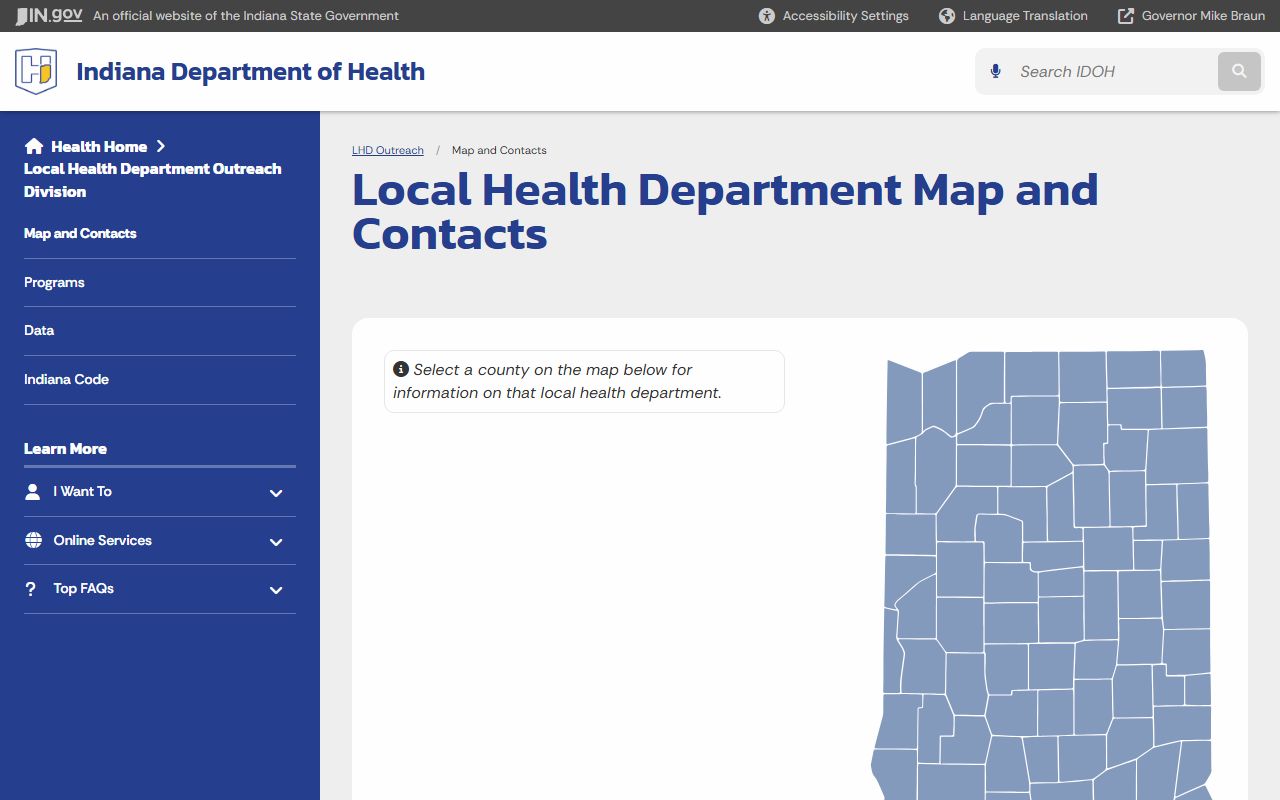 Use this interactive map to quickly identify the right county health office for your Indiana genealogy request.
Indiana State Library Genealogy Division
The Indiana State Library has one of the largest genealogy collections in the Midwest. It is located at 315 West Ohio Street, Indianapolis, IN 46202. Call 317-232-3689 to reach the reference desk. The Genealogy Collection holds more than 40,000 print items, including family histories, record indexes, how-to books, cemetery transcriptions, and family history magazines. Military pension information is also part of the collection. The library places a strong emphasis on Indiana, neighboring states, and eastern and southern states. Staff can assist with in-depth Indiana genealogy searches and direct you to the right collections for your family history work.
Special services help genealogy researchers at the library. On the second Saturday of each month, patrons can book one-on-one family history consultations. On Wednesday afternoons and the second Saturday of each month, volunteers from the Caroline Scott Harrison Chapter of the Daughters of the American Revolution help patrons trace their family lines. These DAR volunteers bring deep knowledge of Indiana genealogy sources. Groups can arrange tours of the Genealogy Collection as well. The library is a FamilySearch Affiliated Service, meaning on-site researchers can access restricted genealogy databases that are not available online at no cost. Hours are Monday through Friday, 8:00 a.m. to 4:30 p.m., with Saturday hours listed on the website.
The Indiana State Library Genealogy Division page lists all available resources, collection guides, finding aids, and online databases for Indiana family history research.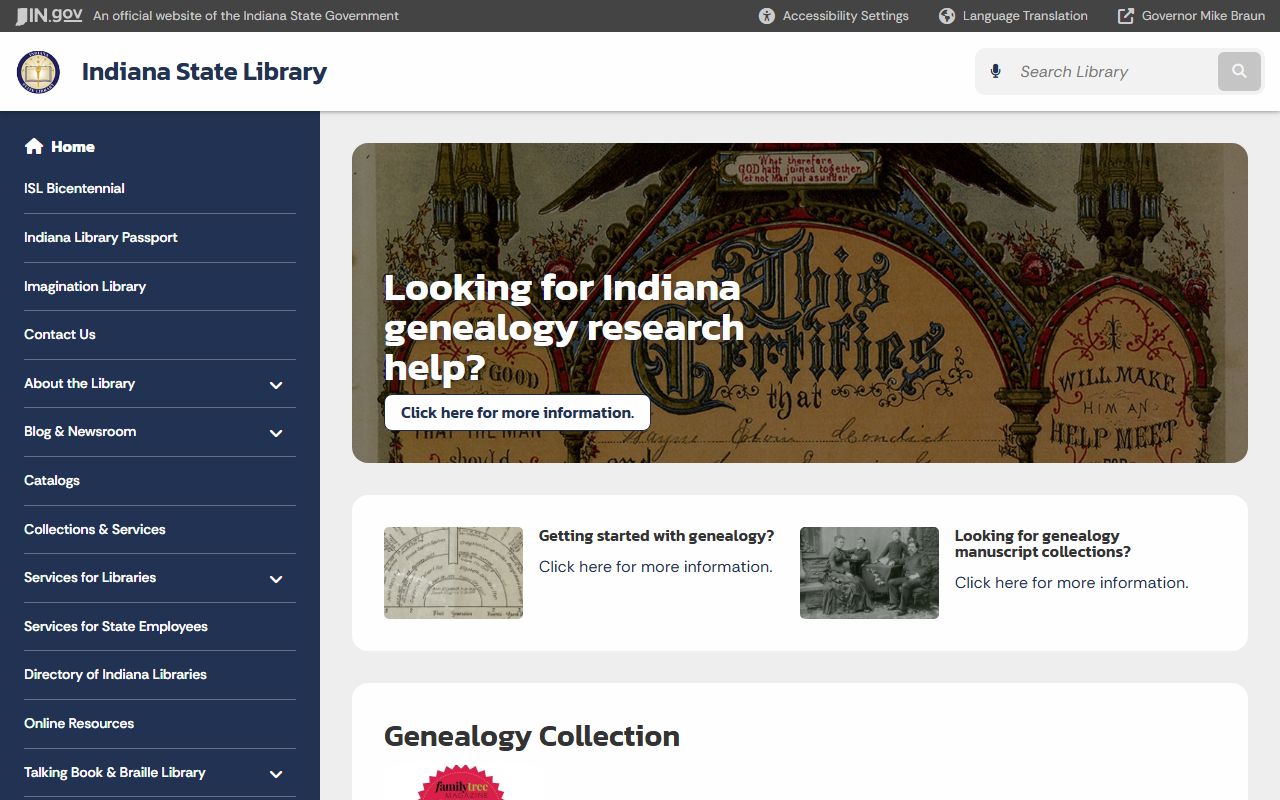 The site includes FamilySearch affiliated services, genealogy manuscript finding aids, and access to the Indiana State Library Digital Collection.
The library publishes county research guides for all 92 Indiana counties. Each guide lists the key records held in that county and the agencies that maintain them. Access them online at the Indiana county research guides page. These guides are one of the best starting points for any Indiana genealogy search.
The Indiana State Archives
The Indiana Archives and Records Administration (IARA) holds older county records, court records, and state records that have been moved out of county offices over the years. The building is at 6440 East 30th Street, Indianapolis, IN 46219. Contact them at (317) 591-5220 or arc@iara.in.gov. The Indiana State Archives is where Indiana records of permanent historical value end up once their retention period at the county or state agency level ends. When a record's retention period closes, it either gets destroyed or transfers to the State Archives to become part of the permanent research collection. Many older court records, land records, and government files no longer held at the county level can be found at the State Archives. IARA also runs the State Imaging and Microfilm Lab, which creates high-quality microfilm following standards designed to keep documents readable for up to 500 years.
The Indiana Archives and Records Administration maintains the state's permanent collection of historical documents used for Indiana genealogy research across all 92 counties.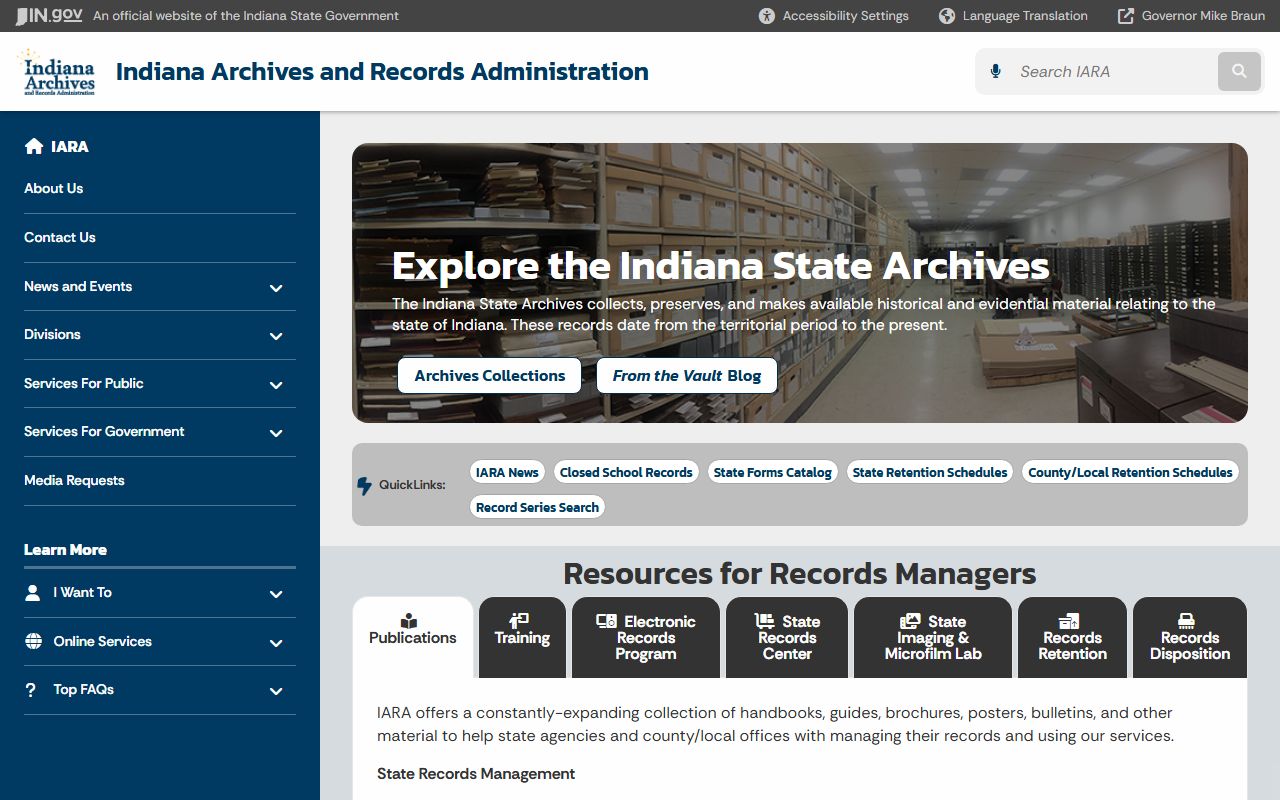 Search the online catalog at researchIndiana.iara.in.gov to find out which records are held at the State Archives.
Historical Resources for Indiana Genealogy
The Indiana Historical Society (IHS) supports family history research throughout the state. Located at 450 W. Ohio St., Indianapolis, IN 46202, the IHS can be reached at (317) 232-1882. Their website at indianahistory.org includes local history services and a county resources page with contacts and collections for all 92 Indiana counties. The IHS has published indexes and research guides for primary source material for more than 50 years. Their resources cover settlement patterns, land transfers, military records, and community documents that support deep Indiana genealogy searches.
Other key resources round out the Indiana genealogy landscape. The Indiana Genealogical Society at indgensoc.org maintains county pages for all 92 Indiana counties, each linking to local historical societies, genealogy clubs, and county-level record collections. FamilySearch has a comprehensive Indiana genealogy wiki at familysearch.org with step-by-step guides for finding Indiana ancestors both online and in person. Many Indiana public libraries are FamilySearch Affiliate Libraries, giving researchers free on-site access to restricted databases. The Works Progress Administration created indexes to Indiana vital records from 1882 to 1920. These WPA indexes are at the Indiana State Library and many county libraries, and they are especially useful for tracing ancestors from the early registration period when statewide records were less complete and county records vary in quality.
The Indiana Historical Society provides local history services and county resource guides to support genealogy research across all Indiana counties. Their county resources page links to collections and contacts for each of Indiana's 92 counties.
How to Request Indiana Genealogy Records
Getting Indiana genealogy records requires knowing which agency holds what you need. For birth and death certificates, start with the county health department in the county where the event occurred. If you are not sure of the county, the IDOH at (317) 233-2700 can point you to the right office. Marriage records require you to contact the County Clerk in the county where the marriage took place. Court records, probate files, and land deeds are held by the County Clerk or County Recorder. Older records may have moved to the Indiana State Archives. Always identify the county of occurrence first. Indiana organizes records by where the event happened, not by where the person lived.
Online ordering is the fastest option for many Indiana genealogy requests. The IDOH uses VitalChek for online birth and death certificate orders. Visit vitalchek.com, select Indiana, enter the details of the person, and pay by credit card. Hamilton County has its own online portal at hamiltoninvitals.permitium.com for local vital records. Other counties may have their own systems as well. For court records and older files, the IARA online catalog at researchIndiana.iara.in.gov provides some online access to archival materials.
Mail requests are an option for both state and county offices. For IDOH records, download Form 49607 for births or Form 49606 for deaths from the IDOH website. Include a photo ID copy and a check or money order for the fee. Mail to 2 N. Meridian St., Indianapolis, IN 46204. County health offices also take mail requests. Contact the specific county first to get its current forms, fees, and mailing address, since these vary across Indiana's 92 counties. Fees typically run between $10 and $20 for certified copies. Genealogy copies for records over 75 years old are often cheaper. Allow several weeks for mail processing at most offices.
The Indiana county research guides from the State Library provide county-specific record details to help you choose the right agency for your Indiana genealogy search.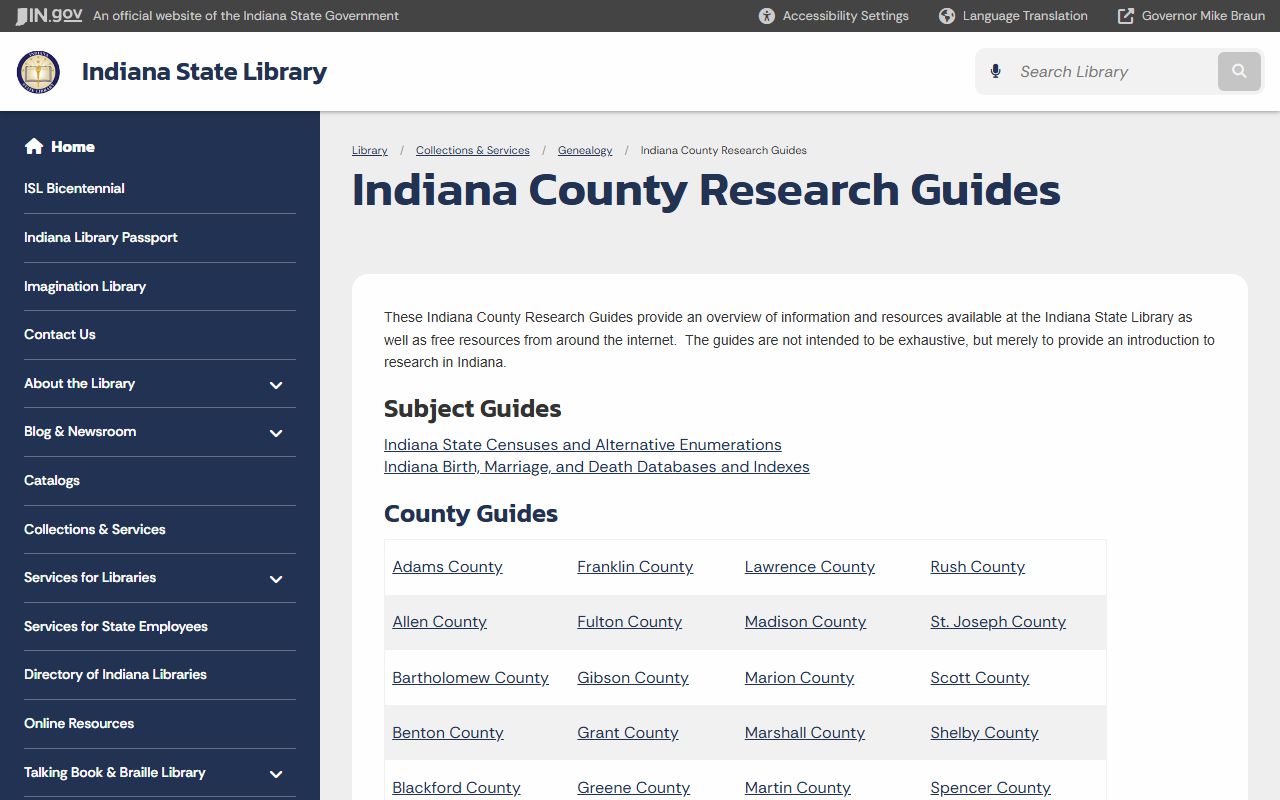 Each guide explains which records exist for that county, the date ranges covered, and which office holds them.
Note: In-person visits to county health offices are often the fastest way to get certified copies, with many offices issuing records on the same day.
Record Access Laws in Indiana
Indiana's public records law gives broad access to government documents. Under Indiana Code 5-14-3, most state and county records are open to the public. Genealogy records held at county health offices, the IDOH, and the State Archives all fall under this law. The statute states that records obtained by a genealogical or historical society remain public records and must follow the same access rules as other public documents. You do not need to be a relative of the person named in a record. No reason is required for most public records requests in Indiana. Every citizen has the right to inspect and copy public records under IC 5-14-3.
Some records carry time-based restrictions. Under IC 5-14-3-4, records classified as confidential generally become available 75 years after their creation date. Birth and adoption records are exceptions that may remain restricted longer. For vital records used in Indiana genealogy research, the IDOH requires that the named person be over 75 years old and deceased before releasing a genealogy copy. Most requests for older Indiana genealogy materials can be processed without special authorization once the 75-year window has passed. Vital records laws governing what the IDOH maintains and how they are issued fall under IC 16-37. Birth records have been required statewide since 1907, with county records going back to 1882. Deaths have been tracked statewide since 1900.
VitalChek processes online orders for Indiana vital records including birth and death certificates requested for genealogy research. A service fee applies on top of state fees when ordering Indiana genealogy records through VitalChek.
Browse Indiana Genealogy Records by County
Each of Indiana's 92 counties keeps its own birth and death records through a local health department and maintains court and marriage records through the County Clerk. Select a county below to find contact details and local genealogy resources.
Genealogy Records in Indiana's Major Cities
Major Indiana cities file vital records through their county health department or a city-level office. Select a city below to find local genealogy record resources and contact information.